
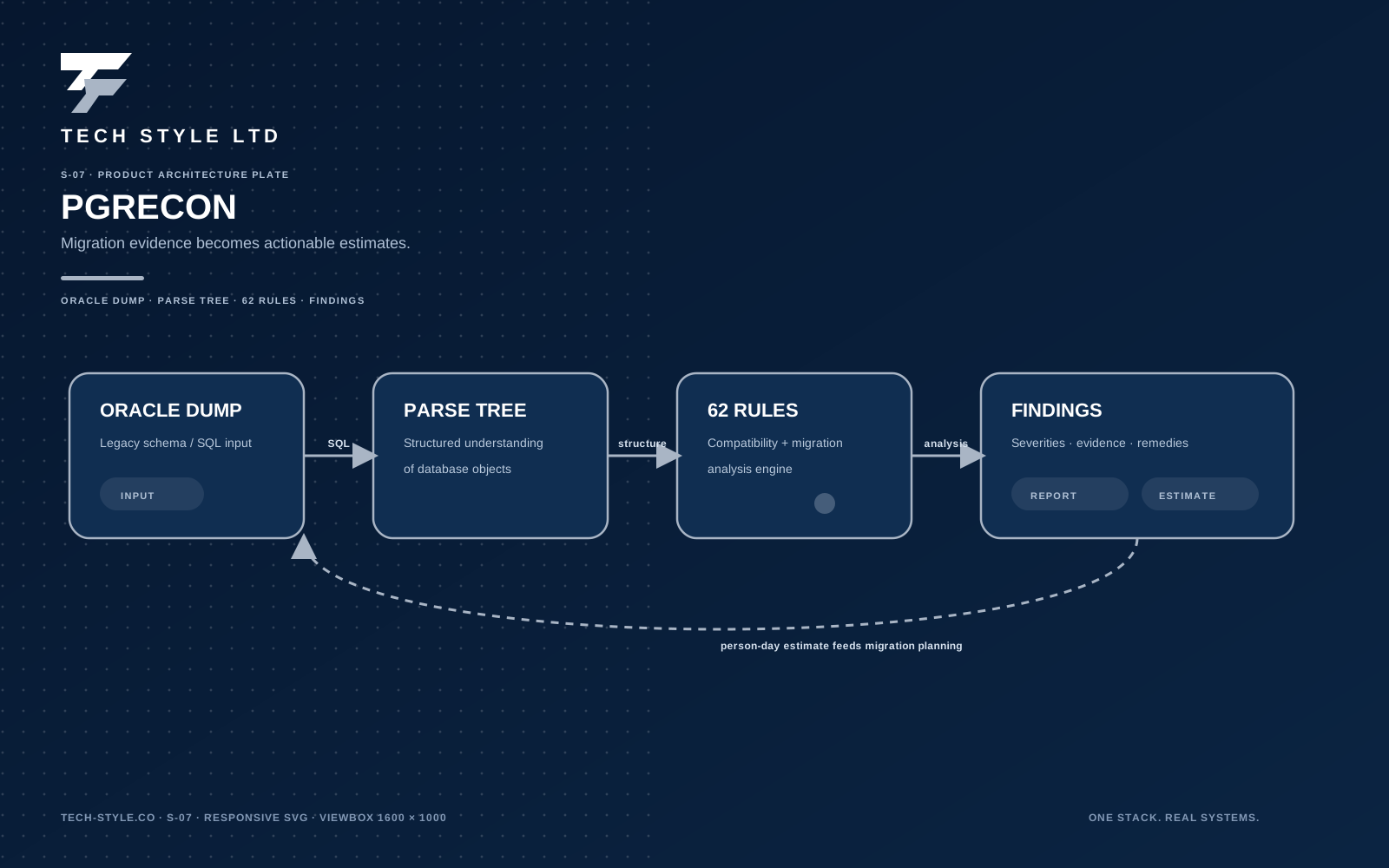
pgrecon
Free, open-source migration reconnaissance. It answers the one question that decides whether an Oracle-to-PostgreSQL migration succeeds or overruns: what is actually in there, and what will it cost to move? It parses your PL/SQL with a real grammar, reports every incompatibility with file-and-line evidence, estimates the effort in person-days, and converts the schema it can prove into PostgreSQL DDL — all without ever connecting to your database.
The tables are the easy part
Oracle licensing pushes organisations towards PostgreSQL, and the schema itself rarely stands in the way — tables, indexes and data move with well-trodden tooling. What sinks the timeline is twenty years of business logic: PL/SQL packages full of Oracle-only constructs that have no direct equivalent on the other side.
Migrations routinely run twelve to eighteen months and overrun their budgets for a single reason — nobody measured the code before committing to the date. The scary parts are discovered in month nine, by which point the plan is already written.
pgrecon is the measurement step. It reads the code you already have, tells you exactly which constructs will not survive the move, shows you where each one lives, and turns that into a defensible number. Run it before anyone signs anything.
We built it because we have done these migrations professionally, including for heavy-industry estates still running very old Oracle versions. The rules are the list of things that hurt us.
- Status
- v0.7.2 on PyPI · alpha
- Licence
- Apache 2.0 — free commercially
- Rules
- 80, each with fixture tests
- Analysis
- Fully offline — no DB connection
SELECTs that your own DBA reads and runs. You send back the output files; analysis happens on a laptop, against a local SQLite inventory. There is no listener to open, no account to create and nothing for a security team to sign off.
Four moves: generate, extract, analyse, convert
The only thing that runs near production is a read-only script your own DBA inspects first.
Generate the extraction script
pgrecon script --source-version 19 writes a SQL*Plus script tailored to your Oracle release. For 9.2 to 11.1 estates, --legacy produces a variant that runs on the older dictionary views.
Your DBA reads it, then runs it
It is plain SELECT statements against the data dictionary — nothing to approve in a change board meeting. sqlplus readonly_user@service @pgrecon_extract.sql SCHEMA_NAME produces a directory of dump files. SQL*Plus is the only requirement on the database server; no Python, no agent, no network access.
Load the dump into a local inventory
pgrecon load dump_dir --db inventory.db parses the extract into a local database — every table, index, package, trigger, view, job and dependency, with the source text of each program unit.
Run the rules
pgrecon report --db inventory.db walks the parse tree with all 80 rules and prints every finding: rule ID, severity from info to blocker, the object it lives in, and the evidence. Add --remedies for what to do about each one, or --format json to feed a tracker.
Price the work
pgrecon estimate --db inventory.db converts the inventory and the findings into a low / expected / high range in person-days, and shows the arithmetic that produced it.
Convert what can be proved
pgrecon convert --db inventory.db emits PostgreSQL DDL for everything it can carry faithfully, and a residue file naming every object it declined and why. Still offline, still from the same inventory.
Write the runbook for the data
pgrecon runbook --db inventory.db does not move rows — it writes what the move needs: a data-only mover configuration, row-count and spot-sum validation SQL for both engines, the post-load sequence and materialised-view steps, and the cutover checklist.
Decide with evidence
You now hold a defensible scope before a single line has been ported — and the same numbers can be re-run against a later extract to show progress.
Want to see it before involving a DBA? A real extraction dump from an Oracle XE 21c instance ships in the repository, so a clone to a first report takes a few minutes with no Oracle instance anywhere. That sample reports 58 findings — 10 high, 18 medium, 16 low, 14 info, on a schema built to be nasty on purpose.
80 rules across nine domains
Every rule ships with fixture tests, a severity, a remediation note and a documented explanation you can read with pgrecon explain RULE_ID.
| Domain | Rules | Representative findings |
|---|---|---|
| PL/SQL code | 18 | Autonomous transactions, dynamic SQL, FORALL, collection types, the empty-string NULL trap |
| Schema objects | 14 | Database links and the remote calls made over them, scheduler jobs, materialised view logs, queues, evolved types, unparseable DDL |
| Storage | 12 | Interval partitioning, global temporary tables, IOTs, read-only tables, bitmap and function-based indexes |
| SQL constructs | 13 | CONNECT BY, Oracle outer-join syntax, ROWNUM, MERGE, SYS_CONTEXT, the MODEL clause, PIVOT, flashback queries |
| Data types | 9 | LONG, XMLTYPE, ROWID, BFILE, SDO_GEOMETRY, BYTE-semantics strings, TIMESTAMP WITH LOCAL TIME ZONE |
| System packages | 5 | UTL_FILE, UTL_HTTP / SMTP / TCP, DBMS_SQL, DBMS_LOB, DBMS_OUTPUT |
| Performance | 5 | Optimiser hints, global indexes on partitioned tables, plan baselines, query-rewrite MVs |
| Environment | 2 | Character-set encoding decision, object grants to migrate |
| Packages | 2 | Package-level state, initialisation blocks |
Evidence, not adjectives
Each finding names the object and the location inside it, so an engineer can open the code and see the problem rather than take the tool's word for it.
Severity that means something
Findings run from info to blocker. A blocker is something with no PostgreSQL equivalent that will require a design decision — not merely a syntax difference.
A remedy per rule
--remedies prints what to do about each finding: the PostgreSQL equivalent, the extension that covers it, or the redesign it forces.
Parse failures are findings
If the parser cannot read a program unit, that is reported as a finding — never silently skipped. Unknown code is a risk, and it is accounted for as one.
Deterministic by design
Same dump in, same findings out. Two people running the same extract get the same report, which is what makes it usable in a commercial conversation.
JSON for the rest of your stack
--format json exports the full finding set for a backlog, a spreadsheet or a dashboard, so the assessment survives the meeting it was made for.
Measured at estate scale
A synthetic estate of 5,000 tables and 100,000 lines of PL/SQL across 1,600 stored units — one of them a 16,000-line package body — loads and deep-parses in under 40 seconds on a laptop, and reports in about two. The generator ships with the source, so the measurement is reproducible rather than quoted.
Fuzzed, not merely tested
An adversarial dump generator throws names past 63 bytes in ASCII and Hangul, names that collide once Oracle's namespaces fold into PostgreSQL's, reserved words as columns, every partition layout and spools in a foreign code page. CI runs a fresh window of seeds nightly and checks that every object the loader stored is either created in the DDL or named in the residue.
A number that shows its own arithmetic
An estimate nobody can interrogate is worth nothing in a budget meeting. pgrecon estimate builds its range from five components — baseline and environment setup, schema conversion, remediating the findings it just reported, porting PL/SQL by volume, and moving the data — and prints the contribution of each.
The output is a low, expected and high figure in person-days, with the person-month equivalent. Because the workings are visible, your team can argue with any line of it and re-run with their own assumptions instead of discarding the whole thing.
Calibration is the honest caveat: the model is built from real project experience, but it does not know your team, your test estate or your change-control overhead. That judgement is what our assessment report adds.
# estimate from the bundled sample inventory
pgrecon estimate --db sample.db

Migration effort estimate (person-days)

  baseline and environment       5.0
  schema conversion              1.7
  finding remediation           74.3
  PL/SQL porting by volume       0.8
  data movement                  0.0
  development subtotal          81.7

With testing and stabilization:
  low 106, expected 131, high 180 person-days
  (5.1 to 8.6 person-months)
Verbatim from the bundled sample database, so you can reproduce it in two minutes. Repeated findings of one rule cost a severity-dependent fraction of the first fix, testing and stabilisation is applied on top, and every run prints its assumptions. Your figures depend entirely on your own code.
It converts what it can prove, and refuses the rest by name
Since v0.2 the same inventory drives a converter, and it now covers schema structure, views, materialised views, triggers, grants and comments end to end on the test estates. pgrecon convert writes two files, offline like everything else. The first is PostgreSQL DDL for what it can carry faithfully: tables under a documented type mapping (NUMBER stays exact, never a float), keys, checks, foreign keys, secondary indexes, native partition children for range, list, hash and composite layouts, views transpiled with (+) joins folded to ANSI, sequences restarted at their extracted position, synonyms as views, database links scaffolded as oracle_fdw servers, generated columns, and standalone functions and procedures whose every construct has a provably equivalent PL/pgSQL form — comments and formatting carried through, SELECT INTO made STRICT so NO_DATA_FOUND still raises.
Inside those routines the top-N idiom converts — a ROWNUM bound over a sorted subquery becomes LIMIT — and MERGE carries over with its action conditions moved onto the WHEN clauses, the SET aliases PostgreSQL rejects dropped, and USING dual made a one-row source. Oracle's date-plus-number arithmetic becomes an explicit INTERVAL, and views that sort, group or compare XML or JSON columns — which PostgreSQL cannot order the way Oracle does — are declined by name.
The second file is the residue: one line per declined object, naming the construct and the line number. Packages, CONNECT BY, autonomous transactions, REF CURSOR interfaces, BULK COLLECT, a ROWNUM sitting beside an ORDER BY — the work that needs a person is refused by name rather than guessed at, and a routine that calls a refused routine is refused with it.
# convert from the same inventory the report came from
pgrecon convert --db inventory.db

  schema_pg.sql       what converts, provably
  schema_residue.txt  what does not, named and located
check_function_bodies on. Whatever the converter cannot carry faithfully becomes a named residue line instead of quietly wrong output — so the gap between "converted" and "done" is a file you can count, not a surprise in testing.
Six converters, one live PostgreSQL
Every converter claims to convert an Oracle schema. The benchmark asks a narrower question: apply the tool's own output to a real PostgreSQL 16, statement by statement — how many statements does PostgreSQL itself reject? Not a missing feature or a style complaint; a statement the target database refuses. That is the bar a real migration hits in production, whether the tool warned about it or not.
| Converter | Statements rejected | Notes |
|---|---|---|
| pgrecon 0.7.2 | 0 | Of 423 statements on the eight public schemas, re-measured in CI on 2026-09-24 — and 0 in the August nine-schema round. Every decline a named residue line |
| CYBERTEC ora_migrator | 40 | Plus two whole-schema crashes; PL/SQL is out of its scope by design and is not counted against it |
| Ora2Pg v25 | 77 | Clean on the simple estates; needed two accommodations to apply at all |
| EDB Migration Toolkit 55.13 | 135 | Of 477 emitted statements — entire package libraries omitted without a word and reported as success |
| AWS SCT | 481 | Clean on HR only; surviving objects depend on the aws_oracle_ext runtime extension |
| Dalibo PostgreSQL Migrator 1.0 | 58 | Of 445 statements on the eight public schemas, run once on 2026-09-19; emits no views or code |
Nine schemas: Oracle's official HR, OE and CO samples, four package-heavy open-source PL/SQL projects (utPLSQL, PLJSON, Logger, Alexandria) and two lab schemas. Source Oracle XE 21c, target a stock postgres:16 container, no compatibility extensions unless a tool's own output required one. The other tools were measured in August 2026 and the Dalibo row in September. Since 0.7.1 the pgrecon row is no longer a one-off: a Benchmark workflow in the repository re-runs it in CI over the eight public schemas, with its runs, logs and SQL public — on top of the converter output being applied to PostgreSQL 16, 17 and 18 on every commit and fuzzed nightly. It is the maintainer's own benchmark, so the method, tool versions, per-tool accommodations and reproduction steps are all published: benchmark methodology ↗.
The whole surface area
One command per step, and nothing hidden behind a service.
pgrecon script | Generate the SQL*Plus extraction script. --source-version targets your Oracle release; --legacy produces the 9.2–11.1 variant. |
|---|---|
pgrecon load | Parse a dump directory into a local inventory database. --encoding handles dumps that are not UTF-8. |
pgrecon report | Run all rules and print the findings. --remedies adds remediation guidance; --format json exports the full set. |
pgrecon explain | Print the full documentation for a single rule ID — what it detects, why it matters and how to resolve it. With no argument it lists the whole catalogue with severities. |
pgrecon estimate | Produce the low / expected / high effort range in person-days, with the component breakdown. |
pgrecon convert | Emit PostgreSQL DDL for everything provably convertible, plus a residue file naming every object it declined and where it lives. |
pgrecon runbook | Write the data-movement artifacts, offline: a data-only mover configuration, row-count and spot-sum validation SQL for both engines, the post-load sequence and materialised-view steps, and the cutover checklist. |
pgrecon info | Summarise an inventory — its metadata, a count of every object type it holds, and how much of the DDL parsed. |
pip install pgrecon

# no Oracle yet? the repository carries a sample dump
git clone https://github.com/Muzzammil242/pgrecon
pgrecon load pgrecon/examples/dump_oracle21c --db sample.db

# or run it against your own estate
pgrecon script --source-version 19
# ... your DBA runs the generated script and returns dump_dir/
pgrecon load dump_dir --db inventory.db
pgrecon report --db inventory.db --remedies
pgrecon estimate --db inventory.db
pgrecon convert --db inventory.db
pgrecon runbook --db inventory.db
Source, rule catalogue and issue tracker live at github.com/Muzzammil242/pgrecon; release notes and the benchmark methodology are published alongside it.
The document that gets the budget approved
The free tool answers the engineer's question — what is in there and what breaks. The assessment report answers the board's: what does this cost, how long does it take, in what order, and what could go wrong.
What you receive
- An executive summary a non-technical sponsor can act on
- Every finding prioritised and rewritten in plain English, with business impact
- A phased migration roadmap — what moves first, what moves last, and why
- A testing and cutover plan, including how you prove equivalence
- A cost and effort estimate calibrated against real migration projects, not just the tool's model
- The risk register: what we would worry about in your specific estate
- A walkthrough call with the engineer who wrote it
How an assessment runs
- Step 1
- Your DBA runs the open-source extract — no access granted to us
- Step 2
- We analyse the dump and interview your team on context
- Step 3
- You receive the report and a walkthrough call
- Fee
- Fixed, agreed before we start
Typical turnaround is two weeks from receiving the dump. The fee is credited against a subsequent migration engagement if you choose to go ahead with us.
What it runs on
| Runtime | Python 3.11 or later, installed from PyPI with pip install pgrecon. |
|---|---|
| Source Oracle | 11.2 and later with the standard script — verified nightly in CI against Oracle XE 21c and Oracle Free 23ai. Oracle 9.2 to 11.1 via pgrecon script --legacy, itself verified nightly in CI against Oracle XE 11g. |
| Target | PostgreSQL. Rules are written against stock PostgreSQL, noting where an extension covers the gap. |
| On the database server | SQL*Plus only. No Python, no agent, no outbound connection. |
| Analysis store | A local single-file inventory database built from the dump. |
| Analysis method | Grammar-based parsing of DDL and PL/SQL into a parse tree — not keyword matching. |
| Output | Terminal report with severities and remedies, JSON export, per-rule explanations, effort estimate, converted PostgreSQL DDL with a named residue file, and a migration runbook. |
| Testing | Every rule carries fixture tests; the suite runs against real Oracle extracts, the converter's output is applied to live PostgreSQL 16, 17 and 18 on every commit, and a fresh window of fuzz seeds runs nightly. |
| Licence | Apache License 2.0. Issues and pull requests welcome. |
Where this fits
Find out what the move really costs
Run the free tool yourself, or send us the dump and we will turn it into a report your board can sign off. Either way you find out before the budget is committed, not during month nine.
- Your DBA keeps control — we never ask for database access.
- A fixed fee agreed up front, credited against the migration if you proceed.
- A reply from the engineer who wrote the tool, usually within one business day.
Prefer to try it first? github.com/Muzzammil242/pgrecon · or email hello@tech-style.co.
Request an assessment
Tell us roughly what you are running and we will come back with scope and fee.